PNL Meaning for eCommerce
Learn the meaning of PNL for eCommerce and how to track profit and loss in your online store. Discover strategies to boost profits, reduce losses, and manage costs efficiently.
January 4, 2026
PNL Meaning for eCommerce: How to Track Your Online Store’s Profit and Loss
If you’re running an online store, you’ve likely come across the term PNL. But what exactly does PNL mean? In eCommerce, PNL stands for Profit and Loss, a vital statement that shows whether your store is making money or losing money.
Understanding PNL is crucial for every online business owner, whether you sell on Shopify, Amazon, or your own website.
What Does PNL Mean in eCommerce?
PNL, or Profit and Loss, is a financial statement that summarizes your online store’s:
Revenue – Money earned from sales
Expenses – Costs including products, shipping, ads, and platform fees
By analyzing your PNL, you can answer critical questions like:
Are my products profitable?
Are my ad campaigns delivering real returns?
How much money do I actually keep after expenses?
In short, your PNL tells you if your store is earning profit or experiencing losses.
Why PNL Is Essential for Online Stores
For eCommerce businesses, PNL is more than accounting—it’s a decision-making tool.
Track Product Profitability
Determine which products bring revenue and which cost more than they earn.Optimize Advertising Spend
Measure ROI from Facebook, Google, or TikTok ads and adjust campaigns accordingly.Manage Operational Costs
Track shipping, platform fees, and payment processing expenses efficiently.Plan for Growth
Identify profitable product lines and allocate resources for scaling your store.
Key Components of an eCommerce PNL
A P&L statement for an online store typically includes the following:
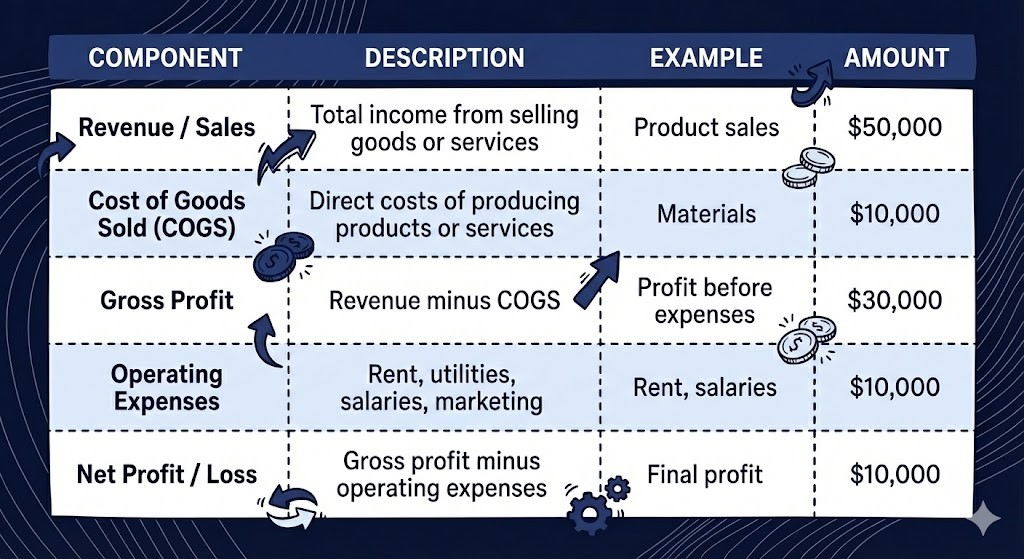
Example: If your Shopify store earned $50,000, spent $20,000 on products, and $12,000 on ads, shipping, and fees, your PNL shows a net profit of $18,000.
How to Read Your eCommerce PNL
To read your PNL effectively:
Start with Revenue – Check total sales from your online store.
Subtract Product Costs (COGS) – Understand profit per product.
Deduct Operating Expenses – Include ads, platform fees, and shipping.
Analyze Net Profit or Loss – Identify profitable products and campaigns.
Compare Periods – Track monthly trends to improve decision-making.
PNL vs Cash Flow
Many online sellers confuse PNL with cash flow:
PNL shows profitability (revenue minus costs) whether money is received or not.
Cash Flow shows actual money in and out of your business.
Example: You may have $5,000 net profit on paper, but delayed payments could create cash flow issues.
Strategies to Improve Your eCommerce PNL
Boosting profits and reducing losses is possible with these steps:
Increase Product Margins – Adjust pricing, bundle products, or negotiate supplier costs.
Optimize Advertising – Focus on campaigns that generate real profit, not just clicks.
Control Shipping & Fees – Find cost-effective logistics or pass some costs to customers.
Automate Profit Tracking – Tools like Syncost track profit, costs, ad spend, and fees automatically, saving time and avoiding spreadsheet errors.
Real-Life Example: Shopify Store PNL
Product | Revenue | COGS | Ads | Platform Fees | Net Profit |
|---|---|---|---|---|---|
Mug A | $5,000 | $2,000 | $500 | $250 | $2,250 |
Mug B | $3,000 | $1,500 | $300 | $150 | $1,050 |
Reviewing your PNL shows Mug A is more profitable. This insight helps you focus on scaling high-performing products.
Final Thoughts
Understanding PNL meaning for eCommerce is critical to running a profitable online store. It helps you:
Identify profitable products
Measure ad campaign effectiveness
Control operational costs
Make data-driven decisions for growth
For e-commerce business owners, automating PNL tracking can make all the difference. Tools like Syncost provide a real-time dashboard for revenue, product costs, ad spend, and fees—so you can focus on growing your store instead of manually calculating profit and loss.
Master your PNL today and make smarter decisions for your online store’s success.
